


The chapter “Dynamic Energy Return on Energy Investment (EROI) of full energy systems in climate mitigation pathways” has just been published, included in the book Net Energy Analysis. Concepts and Methods (Springer), edited by Louis Delannoy and David J. Murphy, whom we thank for the opportunity to contribute. The chapter was written by several researchers from the group (Iñigo Capellán-Pérez, Juan Manuel Campos-Rodríguez, and Carlos de Castro) together with Tristan Martin (a student at École Polytechnique who completed his Master’s thesis with us). Both the chapter and the complete book—available in open access—can be consulted freely here.
What is Net Energy Analysis?
Net Energy Analysis (NEA) is a key concept in Biophysical Economics (Hall & Klitgaard, 2018; Haberl et al. 2019). It evaluates the energy that actually remains available to society after subtracting all the energy needed to obtain it: extraction, transformation, delivery, and all associated indirect energy (for example, that required for the extraction and refining of the required minerals). In other words, NEA helps guide energy planning by distinguishing which sources are more “profitable” for society, by analogy with the return on financial investments (the relationship between benefits and investment). Thus, a source with a very low EROI, such as most conventional biofuels, only makes sense if it is “subsidized” at the system level by other sources with higher EROI, and as long as it does not represent a significant part of the total. Otherwise, it would end up draining an excessive amount of net energy (de Castro et al. 2014).
EROI should not be confused with a measure of efficiency. Although both EROI and efficiency are expressed as ratios between output and input energies, efficiency is bounded between 0 and 1 because output energy depends on input energy, whereas EROI measures energy gained from nature and can be a positive ratio with no upper limit.
This concept of net energy, which intuitively seems key, especially in the context of the energy transition, when large amounts of energy will be needed to put the new system into operation and dismantle the previous one, is nevertheless a blind spot of conventional analyses that do not take this metabolic perspective on energy flows.
However, it should be noted that NEA has historically tended toward static assessments (that is, at the level of the lifetime of a plant) or at the level of a facility without considering the system context. However, energy transitions are by definition dynamic and systemic processes. Therefore, in this chapter we defend the need to calculate EROI (Energy Return on Investment) dynamically and at the level of the complete system, overcoming the limitations of traditional approaches and making it possible to better capture the implications in terms of feasibility for the transition. It should be stressed that, in any case, a sufficiently high EROI is a necessary but not sufficient condition to be able to state that such feasibility is achievable, since a multitude of conditions should be fulfilled (for example, social, financial, sustainability-related, etc.).
The chapter is structured in two parts:
1. Conceptual and methodological framework: it establishes the key principles for a robust EROI assessment in transition contexts, addressing the definition of system boundaries, temporal scope, and scale of analysis. We differentiate between static EROI (aggregated over the lifetime) and dynamic EROI (which captures annual energy flows), arguing why the latter is essential to avoid “energy trap” scenarios during periods of rapid infrastructure deployment.
2. Practical application with the MEDEAS-World model: We illustrate the approach with simulations of the MEDEAS-W model already advanced in the 2019 Energy Strategy Reviews article (Capellán-Pérez et al. 2019) (see post published then), which incorporated three key novelties with respect to the state of the art: (i) dynamic and endogenous calculation of EROI for variable renewable technologies (wind and solar) from material and life-cycle energy requirements; (ii) computation of the EROI of the entire energy system, recognizing the interdependence among complementary technologies; and (iii) feedback to the economic system through the impact on final energy demand.
The results of the Green Growth scenarios with different levels of renewable penetration in the global electricity mix for 2060 show that the dynamic EROI of the system falls below the thresholds considered critical to sustain complex industrial societies. This decline implies an excess demand for energy during the peak of the transition: the system must generate more energy to maintain the same net energy available to society. In addition, a re-materialization of the economy occurs, with cumulative extraction of critical minerals that calls into question the viability of the Green Growth paradigm from a biophysical perspective.
Ongoing work
The methodological approach presented in the chapter has already been implemented and extended in the WILIAM model (v1.4, 2025), which is being extended by incorporating EROI estimates for subtechnologies such as electric batteries and photovoltaic solar panels, as well as new technologies such as hydrogen and carbon capture, along with greater sectoral and technological disaggregation. In future work we will report the results of these simulations, which will make it possible to evaluate the consistency of different decarbonization pathways from a comprehensive net energy perspective.
Online presentation of the book
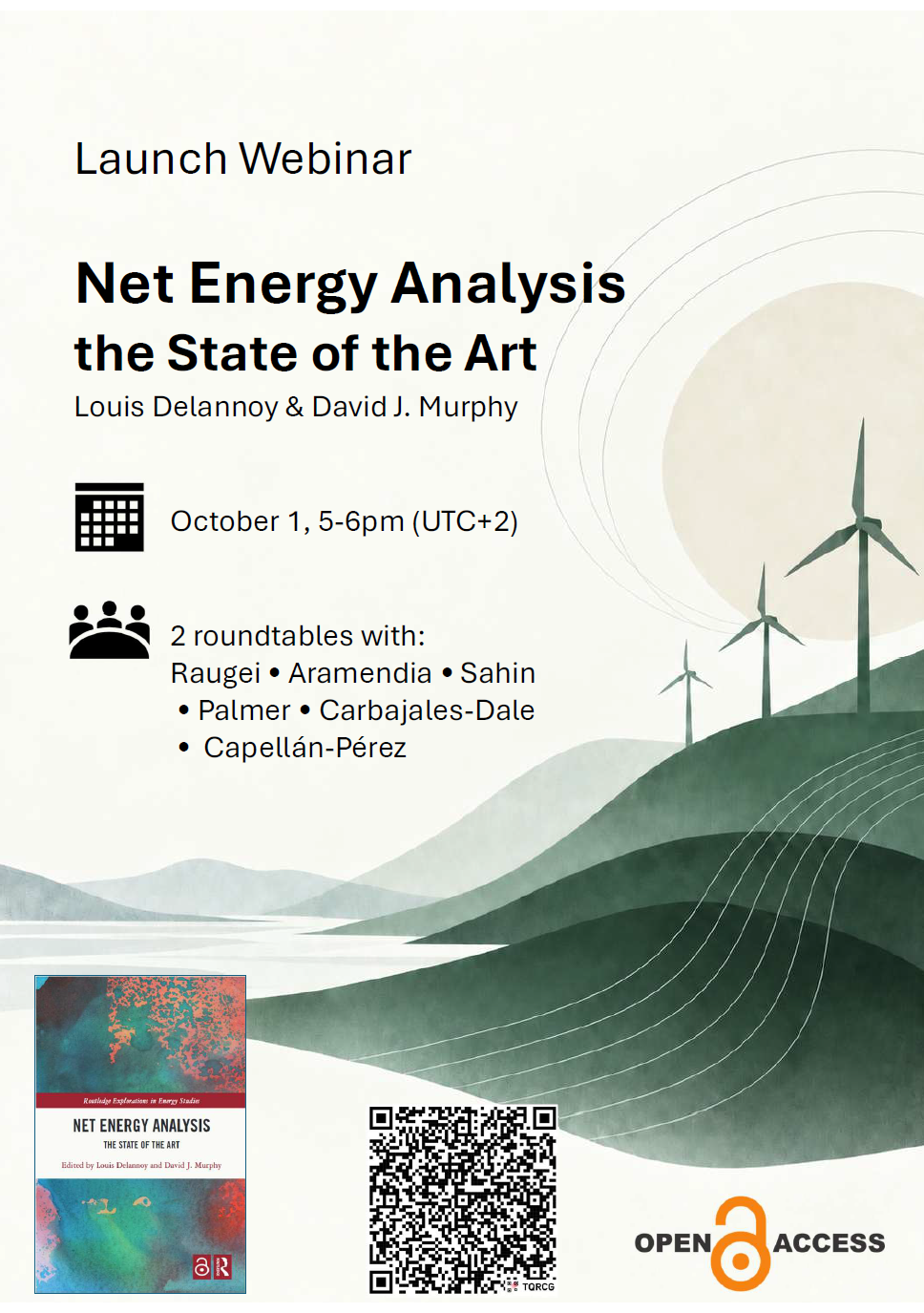
On Thursday, October 1, from 5 to 6 p.m., an online presentation of the book will be held in English with 2 roundtables debating the state of NEA research:
Full citation: Tristan Martin, Iñigo Capellán-Pérez, Juan Manuel Campos-Rodríguez, and Carlos de Castro. “Dynamic Energy Return on Energy Investment (EROI) of Full Energy Systems in Climate Mitigation Pathways.” In Net Energy Analysis: The State of the Art (Ed. Louis Delannoy, David J. Murphy), Louis Delannoy, David J. Murphy. Routledge, 2026. https://doi.org/10.4324/9781003598206.
Other references cited in the post:
- Capellán-Pérez, Iñigo, Carlos de Castro, and Luis Javier Miguel González. “Dynamic Energy Return on Energy Investment (EROI) and Material Requirements in Scenarios of Global Transition to Renewable Energies.” Energy Strategy Reviews 26 (November 2019): 100399. https://doi.org/10.1016/j.esr.2019.100399.
- Castro, Carlos de, Óscar Carpintero, Fernando Frechoso, Margarita Mediavilla, and Luis J. de Miguel. “A Top-down Approach to Assess Physical and Ecological Limits of Biofuels.” Energy 64 (January 2014): 506–12. https://doi.org/10.1016/j.energy.2013.10.049.
- Haberl, Helmut, Dominik Wiedenhofer, Stefan Pauliuk, Fridolin Krausmann, Daniel B. Müller, and Marina Fischer-Kowalski. “Contributions of Sociometabolic Research to Sustainability Science.” Nature Sustainability 2, no. 3 (2019): 173–84. https://doi.org/10.1038/s41893-019-0225-2.
- Hall, Charles A. S., and Kent Klitgaard. Energy and the Wealth of Nations: An Introduction to Biophysical Economics. 2nd ed. Springer International Publishing, 2018. https://www.springer.com/gp/book/9783319662176.